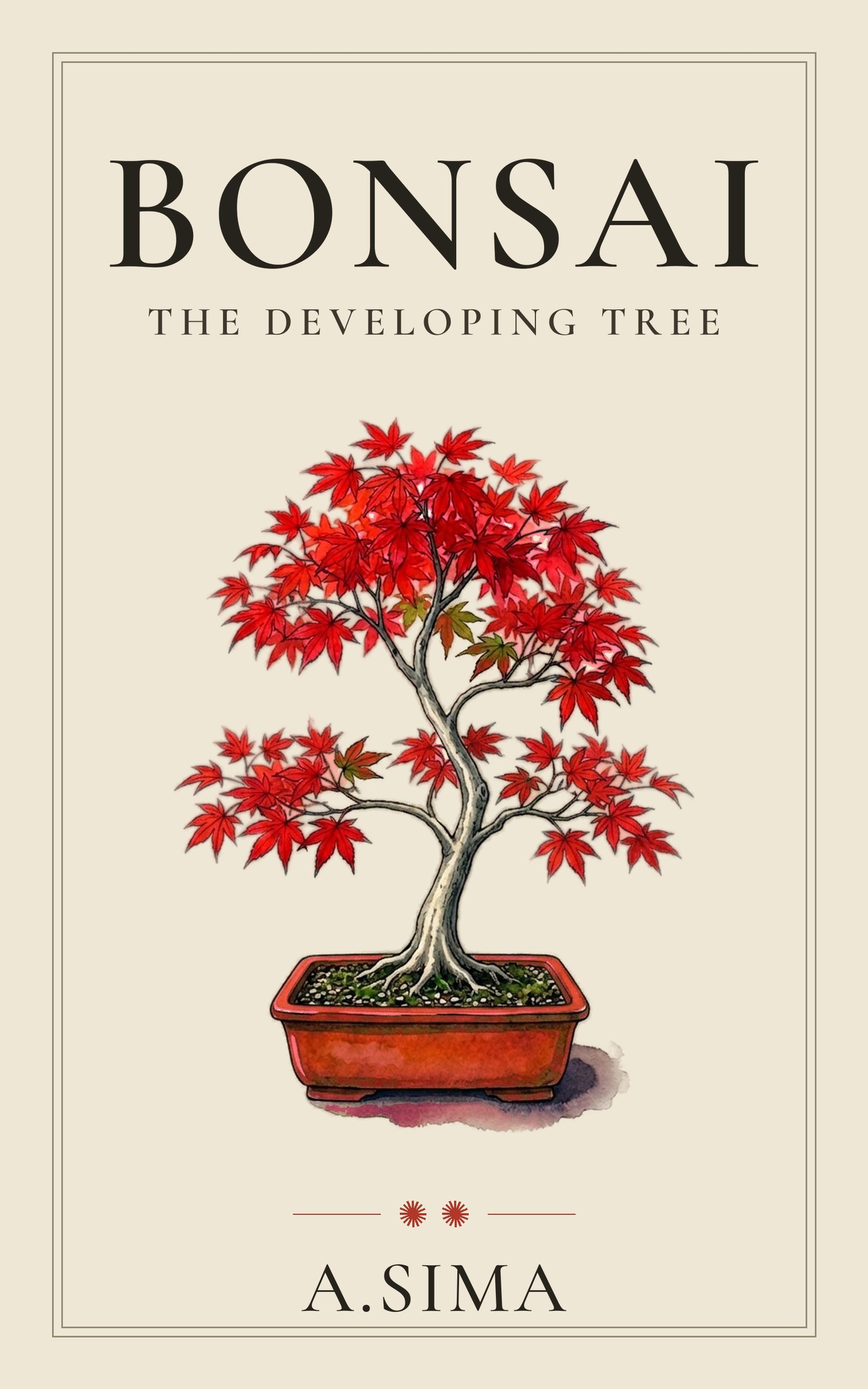
Bonsai: The Developing Tree
Reading Your Tree, Making Decisions, Building Structure
by A. Sima
About the book
Your tree survived its first year. It pushed new growth in spring, came through the winter, and this season it looks much like it did last season — a little fuller, a little leggier. The keep-it-alive questions have answers. This one doesn't, yet: what now?
Beginner books end at survival. Gallery books open on finished trees photographed at forty years old. Almost nothing covers the decade in between, which is where the work actually happens and where most growers quietly stall. The Developing Tree is that decade.
Its argument is that technique is not the hard part. Sequencing is. A grower can execute every technique in the books perfectly and still set a tree back years by deploying them in the wrong order — wiring a branch that should have been left to thicken, building density on a trunk that isn't finished, potting into a show pot three years early. The cut was clean. The year was wrong.
What's inside
- The question every chapter answers first: what phase is this tree in?
- Trunk development through sacrifice branches and the chop-and-grow cycle
- Branch selection, worked start to finish on a fifteen-branch elm
- Wiring taught as drawing rather than mechanics
- Heavy bending, deadwood, and the walk-away threshold where a bend becomes a break
- How ramification actually works — and why pinching junipers has been wrong for decades
- Pines in their own chapter, because candles rewrite every rule
- Soil and feeding tuned to phase, not habit
- Month-by-month development calendars for five North American climates
- A chapter on doing nothing, which is the hardest technique in the book
Who it's for
The grower two or three years in whose trees are alive and going nowhere. The reader of Year One ready for what comes next. Anyone who has bought good material and is afraid of ruining it.
It stands alone. Readers of the first volume will find the vocabulary already familiar.